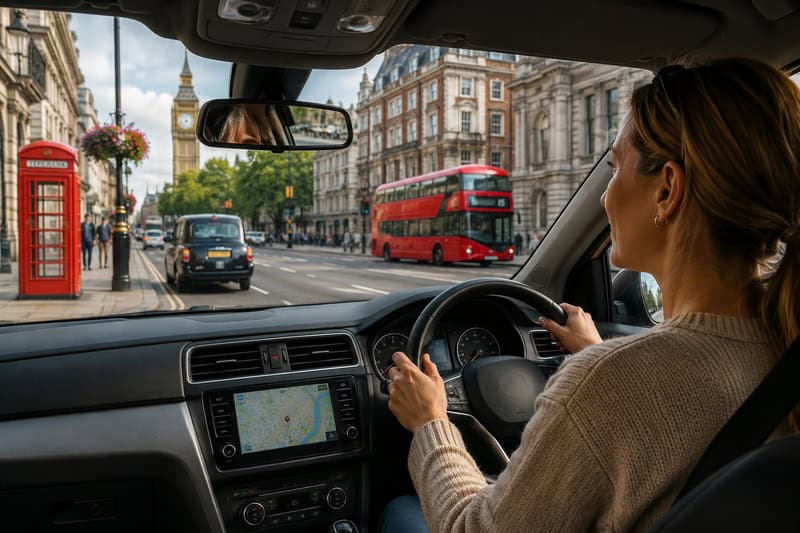
Almost every American who moves to the UK hits the same moment sooner or later. You slide into a car, the steering wheel is on the wrong side, and a roundabout is coming up fast. SDC International Shipping is a licensed FMC moving company that specializes in relocations from the USA to the UK, and driving is one of those topics where a calm plan early on saves a lot of stress later.
The reassuring part is that nobody expects you to have this figured out on arrival. Your US license keeps working for a set period, the route to a UK license is clearly laid out, and most of the road rules click with a little practice. Relocating from the U.S. to the UK involves more steps than most people expect, and this guide covers the driving piece in the order you will meet it: your US license window, getting a UK license, lessons, the rules of the road, and what to do about a car.
One scope note before we start. The rules below apply to England, Scotland, and Wales. Northern Ireland has its own licensing body, the Driver and Vehicle Agency, so check with them directly if that is where you are heading.
| US license valid for driving | 12 months from the date you become a UK resident |
| Swapping a US license for a UK one | Not available: you need a provisional license, the theory test, and the practical test |
| Theory test pass marks | 43 out of 50 questions and 44 out of 75 for hazard perception, passed in one sitting |
| Theory test certificate | Valid for 2 years |
| Practical test fail | More than 15 driving faults, or a single serious or dangerous fault |
| Licensing agency | DVLA in England, Scotland, and Wales; the Driver and Vehicle Agency in Northern Ireland |
| London charging times | Congestion Charge 07:00 to 18:00 Monday to Friday and 12:00 to 18:00 on weekends and bank holidays; ULEZ runs 24 hours a day |
| MOT test | Annual once a vehicle is three years old |
Can Americans Drive in the UK on a US License?
Yes. Americans can drive in the UK on a full, valid US license for 12 months from the date they become a UK resident, according to GOV.UK’s guidance for drivers with a non-GB license. After those 12 months, the same guidance says you need a GB provisional license and must pass both the theory test and the practical test to keep driving.
The clock starts when you become resident, which for most families means the day you arrive to live here, not the day you first get behind the wheel. If you spend your first few months on trains and buses before buying a car, those months still count. The expiry date printed on your US license does not change the deadline either. Your residency date does. That residency usually begins with your visa, and our UK visa guide walks through the routes Americans use.
Driving past the 12-month mark on a US license means driving without a license that is valid for UK roads, and that can put your insurance cover at risk too. The easy fix is to work backward. Put the 12-month point in your calendar the week you land, then plan your provisional license and tests so they finish well before it.
How Do Americans Get a UK Driver’s License?
Americans cannot swap a US license for a UK one, so every new resident goes through a UK provisional license, the theory test, and the practical test. It makes no difference how many clean years you have behind the wheel at home.
A UK provisional driving license is the first-stage license issued by the Driver and Vehicle Licensing Agency (DVLA), the agency that licenses drivers in Great Britain. It lets you take lessons and practice, and you need it before you can book your theory test. Think of it as the UK’s starting line for anyone who has not yet passed a UK test.
Each step unlocks the next, and that is where the planning gets tight. GOV.UK states that you need a provisional license to book the theory test, and that you must pass the theory test before you can book the driving test. Your 12-month window keeps running through all of it, so apply for the provisional license in your first weeks and book the theory test early. Also check how far out practical test slots are at nearby test centers before you assume you can test the week you feel ready.
The theory test has two parts taken together: 50 multiple-choice questions, then a hazard perception test where you click as you spot developing hazards in video clips. GOV.UK sets the pass marks at 43 out of 50 for the questions and 44 out of 75 for hazard perception, and you have to pass both parts in the same sitting. Miss one and you retake the whole test, after waiting at least three working days. The earlier you spot a hazard in a clip, the more points you score, so this is a skill that rewards practice rather than cramming.
A pass certificate lasts two years, and you must pass the practical test inside that window or sit the theory test again. Two years is generous, but it is not a reason to coast.
The practical test is run by the Driver and Vehicle Standards Agency (DVSA). You fail with more than 15 driving faults or with a single serious or dangerous fault, so one nervous moment at a roundabout will not end your attempt, though an unsafe one will. GOV.UK sets no minimum number of lessons before you book, and test routes are not published, so there is no way to rehearse the exact streets.
What Changes After You Pass
Two details catch Americans out once the license arrives. The first is the transmission. If you take the practical test in an automatic car, your license covers automatic cars only, and GOV.UK says upgrading to manual later means passing a manual driving test, though no new theory test is needed. Decide which license you actually want before you book.
The second is the probation period. Under the Road Traffic (New Drivers) Act 1995, the DVLA revokes a license automatically if you collect six or more penalty points within two years of passing your first UK driving test. Points endorsed on your provisional license count toward that total, and a single serious offense, such as using a handheld phone at the wheel, can carry six points by itself. The first two years are the ones to drive carefully.
Do Americans Need Driving Lessons in the UK?
You do not legally need any lessons, but most Americans get real value from a few sessions with an Approved Driving Instructor before the practical test or their first solo drives.
An Approved Driving Instructor, usually shortened to ADI, is registered with the DVSA, and that registration is the one check worth making before you pay anyone to teach you. GOV.UK has a search tool for finding driving instructors near you. Lessons are optional on paper, and in practice they are where the specifics get picked up.
A UK instructor knows what examiners look for: how you position the car on a narrow road, how you approach and leave a roundabout, how you use your mirrors before every change of speed or direction, and how you cope with the independent driving section, where you follow road signs or a sat nav with no turn-by-turn help from the examiner. Experience helps less than you would expect here. Twenty years of clean driving in Texas does not tell your hand where the turn signal stalk is on a right-hand drive car, and it is usually on the opposite side from what you are used to.
Lessons also double as a gentle on-ramp. If you have only ever driven automatics, a session in a manual is a low-pressure way to find out whether you want a manual license at all. And even in your first weeks, when you are still legally driving on your US license, an hour with an instructor beside you is a kinder way to learn left-side driving than a rental car in rush hour.
How Hard Is It to Drive in the UK as an American?
Driving on the left feels strange for the first stretch, and the longer adjustment is learning the UK’s road layouts, rules, and enforcement. The good news is that all of it is learnable, and most of it comes down to a handful of situations.
Roundabouts come first, because they replace many of the intersections you are used to. They run clockwise, and the Highway Code, the official rulebook for UK road users, tells you to give way to traffic approaching from your right, signal your exit, and go when there is a gap. Practice on quiet ones before you tackle a multi-lane roundabout at a busy junction.
Narrow roads are the next surprise, especially in a large SUV. In older towns and villages, cars park on both sides and the single remaining lane is shared by taking turns. In rural Scotland, Wales, and Cornwall you will meet single-track roads with passing places, where one driver pulls in so the other can pass. London is a different challenge altogether, with tight streets, bus lanes, and charging zones, while the country lanes of the Cotswolds trade traffic for tractors and stone walls.
Speed limits are posted in miles per hour, so the numbers feel familiar, but the enforcement is more extensive than most Americans expect. Fixed and average-speed cameras are common, and offenses add penalty points to your license. Treat the posted limit as a limit rather than a suggestion, and set a navigation app with speed camera alerts while you are building a feel for local roads.
At a zebra crossing, marked by black and white stripes and flashing amber beacons, you must stop for anyone who has stepped onto the crossing, and you should slow down and be ready to stop for people waiting at the curb. It is an easy rule to miss at first, because crossings can appear without much warning.
London adds its own layer of rules. Transport for London states that the Congestion Charge applies from 07:00 to 18:00 Monday to Friday and from 12:00 to 18:00 on weekends and bank holidays, so weekend mornings are free of the charge but afternoons are not. The Ultra Low Emission Zone, known as ULEZ, covers every London borough and operates 24 hours a day, every day except Christmas Day, with a daily charge for vehicles that do not meet its emissions standard. Transport for London also states that owners of non-UK-registered vehicles must meet that standard or pay the daily charge. Both schemes are camera-enforced, so an unpaid charge becomes a penalty notice. Several other UK cities run clean air zones of their own, so check the city before your first drive into the center.
Parking rewards slow reading. A single yellow line means restricted hours shown on a nearby sign, double yellow lines generally mean no waiting at any time, and many residential streets are resident-permit only. When in doubt, use a car park. It will cost less than a penalty notice.
Should You Rent, Buy, or Ship a Car to the UK?
The right choice depends on how long you are staying, where you will live, and how much a comparable car would cost to replace in the UK. Each option suits a different situation, and none of them is wrong.
Renting suits the first weeks or months, particularly while a shipment is in transit, but it rarely makes sense as a long-term plan. Buying a used car locally is the usual answer for families staying a year or more. Before you commit to one, check its MOT history, its road tax status, and whether it meets the emissions rules for the areas you plan to drive in.
Shipping your own car makes sense when it would be hard to replace or when it matters to you. SDC ships vehicles only in containers alongside household goods, never as a standalone car-shipping service, and our car shipping to the UK page explains how that works.
Once a car is in the UK to stay, the paperwork follows a set order. GOV.UK sets out the sequence: your shipping company or customs agent makes the import declaration, VAT and duty are settled at the border, and you tell HM Revenue and Customs (HMRC) within 14 days that the vehicle has arrived, using the Notification of Vehicle Arrivals service, known as NOVA. The vehicle then needs approval if it requires it, registration and tax with the DVLA, and insurance before it goes on the road.
The friction point is the order itself. NOVA comes before DVLA registration, so a delay there holds up everything after it, and GOV.UK warns that you can be prosecuted for using the vehicle on a public road before the steps are complete. The only exception is driving it to a pre-booked MOT or vehicle approval test. A US-market car that is not registered in the EU generally needs Individual Vehicle Approval, unless it was first registered or manufactured more than 10 years ago, in which case GOV.UK says approval might not be needed.
If you are moving permanently, you may also qualify for Transfer of Residence relief from VAT and duty on the vehicle, which HMRC approves through its ToR1 form. Our UK customs forms page explains how ToR1 works.
Insurance, MOT, and Road Tax
UK vehicle ownership comes with three standing requirements: insurance before the car goes on the road, a Ministry of Transport test, known as the MOT, once the car is old enough, and vehicle tax paid to the DVLA.
Insurance is compulsory for any vehicle on UK public roads, and GOV.UK specifically says to insure an imported vehicle before you drive it. Policies list the drivers they cover, so ask who needs to be named. Keep your US driving record and your previous insurance letters handy, because some insurers weigh them when pricing a policy and having them widens your options. Cover for the shipment itself is a separate question, and our page on international moving insurance for your UK relocation explains the options.
The MOT is the annual roadworthiness inspection required once a car is three years old. It checks brakes, tires, lights, emissions, and other safety points. Without a valid MOT a vehicle generally cannot be driven on public roads, apart from a drive to a pre-booked test. If you are buying a used car, look at the MOT history and expiry date, and budget for any repairs needed to pass.
Vehicle Excise Duty, usually called road tax, is paid to the DVLA, and the rate depends on factors such as the vehicle’s CO2 emissions, fuel type, and registration date. There is no paper disc to display. Your payment is tied to your registration number and checked electronically by camera. Look up the current rate for the specific car before you buy.
Frequently Asked Questions
Can I drive in the UK with a US license?
Yes, for 12 months from the date you become a UK resident. After that, you need a GB provisional license and must pass both the theory and practical tests to keep driving. Your residency date sets the deadline, not the day you first drive and not the expiry date on your US license.
Do I have to take a driving test to get a UK license as an American?
You do. GOV.UK offers no exchange route for US licenses, so you apply for a provisional license, pass the theory test, then pass the practical test with a DVSA examiner. The theory test needs 43 out of 50 on the questions and 44 out of 75 on hazard perception, both in one sitting.
Do Americans need driving lessons before driving in the UK?
Not legally. Under GOV.UK’s rules there is no minimum number of lessons before the test. Most Americans still book a few with an Approved Driving Instructor, because roundabouts, right-hand drive controls, and the examiner’s expectations are different from anything at home. Check that the instructor is DVSA-registered before you pay.
Is it hard to drive in the UK or London as an American?
It is manageable outside big cities, and London is the tougher test. The left-hand driving settles in with practice, but London adds the Congestion Charge, a city-wide ULEZ, bus lanes, and tight streets. Many people start on quieter roads and bring a car into the center only once they know which charges apply to it.
If a car is part of your move, SDC can coordinate it inside your container with the rest of your household goods. Call us at (888) 909-3020, or read how international moving to the UK works for a look at what we handle from first call to delivery.