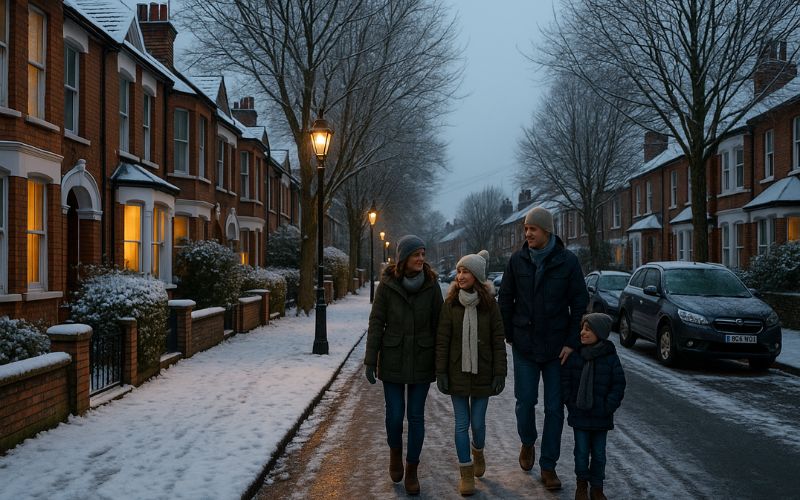
Why London in winter feels different from the brochures
When you picture London before you move, you may see postcard scenes, summer walks along the Thames, leafy parks, and bright double-decker buses. If you arrive or start house hunting in winter, the city can feel very different. The sun sets early, often before 4 p.m., the air stays cool and damp, and the sky leans toward soft gray more often than bright blue.
For American families, especially those coming from California, Texas, Florida, or other sun-soaked states, this can be a shock. The rhythm of your day shifts. School pickups and grocery runs often happen in the dark. You notice whether a street feels safe and welcoming at night, how close the bus stop really is, and whether the walk from the Tube to your front door feels comfortable when it is raining and you are carrying backpacks and shopping bags.
This is why a winter-focused view of London neighborhoods matters. The same area that feels lively and charming in July might feel isolated in January. On the other hand, some places truly shine in cold months, with cosy cafes, well-lit high streets, and parks that still feel inviting even when everyone is in a wool hat.
The emotional side of a winter move
Winter amplifies whatever you are feeling about your relocation. Excitement about a new chapter can sit right beside homesickness. Kids notice that their old routines are gone. They may remember warm New Year’s gatherings or bright winter days in the States and compare them to drizzle on the pavement and a classroom full of new accents.
Parents carry their own worries. You are trying to make smart choices about rent, school catchment areas, commute times, and shipping dates, all while adjusting to a new culture. Shorter days can make it harder to explore. You might only see a neighborhood in the half-light of late afternoon, which makes things like street lighting, bus frequency, and the distance to the nearest shop feel even more important.
A helpful way to frame it is this, winter gives you an honest look at what daily life will be like. If you can imagine your family thriving in an area during the dark, chilly months, it will likely feel even better when spring and summer arrive.
What American families notice first in London neighborhoods
The first few weeks in London teach you quickly which neighborhood details matter in winter.
Families often talk about three things.
First, access. How far is the walk to the Tube, reliable bus routes, or the nearest train station, and what is that walk like in the rain with children? Are the pavements wide enough for a stroller, are there safe crossings, do you feel comfortable coming home in the early evening when it is already dark?
Second, the high street. Many London neighborhoods have a main shopping street with small supermarkets, chemists, cafes, and takeaways. In winter, this becomes the heartbeat of family life. A well lit high street with a good grocery store, a bakery, and a couple of friendly cafes can make a huge difference when you do not feel like trekking into central London with tired kids.
Third, green space. Even in winter, parks matter. They may not look lush, but they give children room to run, ride scooters, or meet friends after school. Places like Richmond, Hampstead, or Greenwich feel different partly because their parks and commons give families somewhere to breathe on cold weekend mornings.
How winter changes your list of “must haves”
When families in the U S think about choosing a neighborhood, they often start with square footage and school rankings. In London, those still matter, but winter adds another layer. You may decide that a slightly smaller flat in a well-connected, lively area beats a larger house that leaves you feeling cut off when the weather is gray.
You might move walkability higher up the list, since walking is part of everyday life in the UK. Being near a park, library, or leisure center becomes especially valuable when the weather keeps you from long outings. Even the feel of the local community matters more, you may notice whether neighbors say hello, whether you see other families on the street, and whether local shops feel welcoming.
This is also where a specialist international mover becomes part of the story. When SDC International Shipping coordinates a move from the U S to the UK, families often share that their biggest relief is knowing the logistics are handled, so they can focus on neighborhood visits, school tours, and getting to know the city. Taking stress out of the shipping side gives you more energy to pay attention to the details that really shape your winter life in London.
Seeing winter as a true test run
The good news is that if you choose your neighborhood with winter in mind, almost everything feels easier later. Spring brings longer days and blossoming trees. Summer fills parks, riversides, and outdoor markets with life. The commute that felt a little tough in January may feel pleasant when the evenings are light and mild.
So as you read through the following sections on central, west, north, and southeast London, keep this lens in mind. Picture your family there on a rainy Tuesday at 5 p.m., not just on a sunny Saturday in June. If you can find places that feel warm, practical, and welcoming in the cold months, you are already well on your way to building a London life that works for your entire family.
Understanding London’s Layout, Zones, Commutes, and Winter Reality
How the city is organised
When you first see a London transport map, it can feel like a puzzle. Instead of thinking in suburbs, many locals think in zones and lines. Zone one is the historic and commercial core, zone two wraps around it, and so on. As you move outward, homes usually become larger and greener, while commutes often become longer.
For American families, this system matters more in winter. Those pretty coloured Tube lines are not just a novelty, they are your lifeline when it is cold and drizzly. A home that looks only a little far on a map might feel very far when it includes a ten-minute walk to the station, a change of trains, and then another walk in the dark at the other end. Looking at a map with winter eyes means paying attention to how many steps are actually involved.
Commutes when the days are short
In the U S, many people are used to driving door to door. In London, even families who own a car still rely on public transport for a large share of their week. The commute that looks fine on paper can feel different when it is wet, crowded, and dark for much of the day.
Parents who work in central London often say they are happiest when their commute involves a single train or Tube line with a short walk at each end. If you have children in school, you also need to think about their journeys. Secondary school students commonly travel independently, sometimes across several neighbourhoods. In winter, you will want routes that feel safe, well-lit, and not overly complicated.
If you want a deeper dive into how buses, trains, and the Tube work together for newcomers, you can always pair this neighbourhood research with the guidance in your site’s transport article at
https://www.movefromusatouk.com/public-transportation-moving-to-uk-from-california/
Why “feel” on the street matters so much in winter
In summer, you might enjoy a longer walk home because the evenings are bright and warm. In winter, you may feel very differently about the same route. That is why it helps to pay attention to the small details. Are there pavements on both sides of the street? Are there other people around at typical school and work times? Are there shops or cafes open, or does the area feel deserted after four in the afternoon?
Many American parents find that they are willing to compromise on square footage if it means a better everyday experience. A slightly smaller flat near a busy, well-lit high street and a reliable Tube line can be worth more than an extra bedroom in a quiet pocket that feels isolated on cold evenings.
How SDC helps you focus on the important decisions
Sorting all this out can feel overwhelming while you are also planning an international move. This is exactly where a specialist mover becomes part of your support system. When SDC manages your packing, ocean freight, customs clearance, and delivery, you gain back mental space that you can spend on neighbourhood visits and school research instead of shipping details.
Many families find it useful to line up their first accommodation in an area that is “good enough” and then use the first winter months to confirm whether it truly fits. Knowing your belongings are on their way and handled by professionals makes any later adjustment easier, because you are not juggling logistics alone.
Central and Inner West London, Convenience and Culture in the Cold Months
Central and inner west London are often the first areas American families imagine. They are the places that appear in films, travel shows, and Instagram photos. In winter, these neighbourhoods can be both magical and practical, but they also come with trade-offs that matter for families.
Everyday life in central neighbourhoods
Areas such as Kensington, Chelsea, Marylebone, and parts of Southbank place you close to world-class museums, famous parks, and major transport hubs. In winter, that convenience is powerful. On a gray Saturday, you can take the children to the Natural History Museum, the Science Museum, or the National Gallery without planning a full day trip. Indoor attractions become your rescue plan when the weather turns.
Streets in these central zones tend to be well-lit and busy, which can feel reassuring during dark afternoons. High streets are lined with cafes, small supermarkets, and pharmacies, so a forgotten ingredient or a last minute school supply usually means a short walk rather than a long drive.
The trade off is space. Many homes are flats rather than houses, with smaller bedrooms and little or no private outdoor space. Rents are higher, and you may find that you are paying more per square foot than you ever have before. For some families, the ease of living outweighs the lack of space. For others, it feels too tight once the initial excitement fades.
Inner west, a blend of village feel and city access
If you move a little farther west into places like Hammersmith, Fulham, or parts of Notting Hill and Maida Vale, you begin to feel more of a neighbourhood rhythm. In winter, this can be a sweet spot. You still have strong transport links into central London, often with multiple Tube lines or bus routes, but your local streets feel calmer and more residential.
Local primary schools, playgrounds, and family-friendly cafes give children an easier sense of belonging. Many of these areas sit near the Thames or large green spaces, which means you have somewhere to walk on chilly weekends. A brisk loop along the river or through a park becomes part of your routine, even when everyone is bundled in coats and wool hats.
How these areas feel to American families in winter
Families who choose central or inner west neighbourhoods often say that winter helped them see the true value of convenience. When it is dark early, the ability to walk to school, to a Tube station, and to a grocery store without long journeys becomes a real comfort. They feel connected, less isolated, and more quickly integrated into city life.
On the other hand, some parents notice cabin fever more easily in smaller flats during long stretches of rain. If you have young children who need room to run, you will lean heavily on nearby parks, museums, and leisure centres. It helps to think honestly about how your family spends time. If you value walkable amenities and cultural access, these neighbourhoods can be a strong match. If you crave a garden and more indoor space, you may want to look slightly farther out.
Using existing resources while you compare
As you narrow your options, it can help to pair this winter focused view with broader city comparisons. For example, your London versus Manchester guide at
https://www.movefromusatouk.com/london-vs-manchester-american-families/
and your best cities overview at
https://www.movefromusatouk.com/best-uk-cities-american-expats/
can remind you why London felt right for your family in the first place.
From there, central and inner west London give you a starting point, a way to experience classic city living with the comfort of strong transport, bright high streets, and endless indoor activities that truly matter when the weather turns cold.
Southwest and West London, Leafy Neighborhoods with a Village Feel
Why many American families gravitate to this side of the city
When American parents picture a gentle landing in London, they often imagine somewhere green, walkable, and slightly calmer than the busy streets of the center. Southwest and west London deliver that feeling for many families. Areas such as Richmond, Kew, Chiswick, Wimbledon, Ealing, and Kingston combine tree-lined streets, riverside paths, and high streets that feel like small towns.
In winter, that village atmosphere becomes especially important. Short days feel softer when you can walk to a cosy cafe, a butcher, a pharmacy, and a small grocery store without navigating huge crowds. Christmas lights along a local high street, a Saturday visit to a market, or a stroll by the Thames in a warm coat offer a sense of belonging that helps ease homesickness.
What winter days really look like here
On a weekday, life in these areas often starts with a walk or short bus ride to school. Many families choose this part of London precisely because primary schools are close and the pace feels slower. After school, you might stop at the bakery, run into a classmate on the pavement, then head to a nearby park even if it is chilly. Places like Richmond Park, Wimbledon Common, and Gunnersbury Park stay busy year round with families walking dogs, children on scooters, and runners in wool hats.
When the weather is wet, indoor options matter. In southwest and west London, you will find libraries, leisure centers with swimming pools, local cinemas, and plenty of cafes where you can warm up with a hot chocolate. Central London remains reachable for museum visits, but you do not have to rely on it every weekend, which is a relief when it is cold and everyone is tired from a long week.
Space, budgets, and expectations
Compared with central neighbourhoods, homes here are more likely to be terraced or semi-detached houses, or larger flats in low rise buildings. You may find three bedroom homes that would be impossible to afford in the very center, along with small gardens or at least shared outdoor space. For children who are used to playing in a yard, this can make winter feel less claustrophobic.
The tradeoff is that commutes into central London are usually longer. Many parents travel into the city on direct train lines from Richmond, Wimbledon, Ealing Broadway, or Kingston. Trains and the Underground still run frequently, but you will spend more time on them compared with a central address. In winter, that means more mornings and evenings in a coat on a platform. Choosing this area often comes down to deciding that extra commute time is worth it for more space and a calmer environment for children.
Community and support during your first winter
One of the biggest advantages of southwest and west London for newcomers is how quickly families can build community. School playgrounds, sports clubs, and faith communities bring parents together. Seasonal events, such as Christmas fairs, carol services, and charity runs, give you reasons to meet neighbours even in the cold.
When SDC handles the logistics of your shipment, you can say yes more easily to those invitations. Instead of spending every spare moment tracking boxes or worrying about customs, you have time to watch your child play football on a muddy field, join a neighbour for a tea, or explore a local shop that becomes “your place.” Those small moments build a sense of stability that matters even more in winter.
North and Northwest London, Parks, Schools, and Quiet Streets
A different kind of London view
North and northwest London offer another version of family life that appeals to many Americans. Neighbourhoods such as Hampstead, Belsize Park, Highgate, Muswell Hill, Crouch End, Finchley, and parts of Queens Park and West Hampstead feel residential and slightly artistic. Terraced houses line hilly streets, independent shops cluster around crossroads, and large green spaces sit at the heart of daily life.
In winter, the landscape can be striking. Bare trees outline the sky above Hampstead Heath, lights from homes glow along steep streets, and cafes fill with locals hiding from the cold. If you like the idea of a neighbourhood that feels like a real community rather than a pure commuter hub, this area may speak to you.
Life around the parks in cold months
The parks and commons in this part of London are a major draw. Hampstead Heath, Waterlow Park, Alexandra Park, and nearby green spaces give families room to roam. Even on cold weekends, you will see people walking, running, and playing football, with children bundled up and dogs racing across the grass.
American parents often say that long walks on Hampstead Heath became their winter ritual. You climb to Parliament Hill for a view of the city, then duck into a cafe for soup or a pastry. It feels like a break from the intensity of central London while still being only a few stops away on the Tube.
Schools, homes, and winter routines
Many north and northwest neighbourhoods are known for strong state schools and a range of independent schools, which can be important for families planning to stay for several years. Street layouts often make school runs simple, with many children walking or riding scooters with friends. In winter, that kind of close by school access means shorter journeys in the dark and less time waiting at bus stops with cold hands.
Homes here vary widely. Some streets have large Victorian houses that have been divided into flats, while others offer full houses with small gardens. Space is still at a premium compared with many US cities, but families often feel they get a better balance of size and location than in central zones. The quiet character of residential streets can be a blessing after a long day, especially during winter when you want home to feel like a refuge.
Connectivity and the feel of the journey
Transport across north and northwest London depends on a mix of Underground lines, Overground trains, and buses. Journeys into central London can be very straightforward from areas served by the Northern, Jubilee, or Metropolitan lines. From more elevated, village like spots such as Muswell Hill, you may rely more on buses that connect you to Tube stations.
In winter, this means your daily routine might include a bus ride down a hill to catch a train, with beautiful views on clear days and misty ones alike. Some families love this layered journey and enjoy the sense of separation between home and the busy center. Others prefer to be closer to a main Underground station. During your first scouting visits, it helps to try routes at typical commute times, not just on quiet weekends.
Finding your place in a quieter corner of the city
North and northwest London often suit families who value community, green space, and a slightly slower rhythm more than they value immediate access to the main tourist sights. Bookshops, independent cinemas, music schools, and local theatres add texture to daily life. You might join a choir, a running club, or a parents group that meets at a local cafe, and soon you know faces on the street even when the weather is chilly.
As with any international move, having SDC oversee your shipment means you can commit to exploring these neighbourhoods properly. You have the freedom to walk the same street in the morning, afternoon, and early evening, really noticing how it feels. That kind of attention leads to better decisions, which is exactly what you want when you are choosing not just a house, but a new life for your family.
East and Southeast London, Character, Value, and Growing Family Communities
Why more families are looking east and southeast
For a long time, many American families only heard about central and west London when planning a move. In recent years, east and southeast London have become much more popular with expats who want character, relative value, and access to both river and green space. Places such as Greenwich, Blackheath, Canary Wharf, Deptford, Lewisham, Bromley, and Beckenham often appear on shortlists once families start to look beyond the most obvious postcodes.
In winter, these areas can feel surprisingly cosy. Old high streets, historic buildings, and riverside paths give everyday life a sense of place. You still get all the practical things you need, supermarkets, pharmacies, coffee shops, and schools, but in settings that feel a little more relaxed and less tourist focused than the very center.
Life along the river and on the hill
Greenwich and Blackheath offer two very different flavours that work beautifully in cold months. In Greenwich, you have the covered market, the Cutty Sark, the park, and the river all close together. On a chilly Saturday you can walk through the market, grab something warm to eat, then climb the hill in Greenwich Park for a view over the city. Christmas lights and winter events add to the atmosphere.
Blackheath feels more like a village, with a wide open heath that stays busy year round and a compact centre filled with shops and restaurants. Even on a gray day, there is a sense of community. Children ride scooters across the heath, families walk to brunch, and locals pop in and out of the same independent businesses they use all year.
Farther out, places such as Bromley and Beckenham offer larger homes and strong schools. In winter, you notice the benefit of quieter streets and easy access to parks and woodlands, but you are still linked to central London by trains and the newer Elizabeth line in certain directions.
Commuting and transport reality in the colder months
East and southeast London rely on a mix of trains, the Underground, the Docklands Light Railway, the Overground, and an extensive bus network. From areas around Canary Wharf, you are exceptionally well-connected, which can make winter commuting feel fairly straightforward. From more suburban areas, you will likely depend on rail services into the main London terminals, followed by a short walk or Tube ride.
The key is to test the journey at typical times if you can. A station that feels close on a sunny afternoon may feel farther on a dark, rainy morning with children in school uniforms. Some families decide that a slightly longer commute is worth it for more space and a calmer neighbourhood. Others want the shortest possible journey and aim for places with very frequent services, even if that means a smaller home.
Character and value through a winter lens
One reason many families choose east or southeast London is the feeling that they are getting more for their money. Homes can be larger, and gardens more common, than in equally priced central or west areas. For children who are used to outdoor space, this makes winter feel much less confined.
At the same time, regenerating neighbourhoods can feel a little uneven. One street may feel polished and lively, while the next still feels in transition. In winter, this contrast is more visible. It is worth walking around at the times you would normally be out, early morning, after school, and early evening, so you know how the area feels when the sun is low in the sky.
While you are exploring, you can lean on the practical support of SDC for the logistics of your move. Knowing that your belongings, including winter coats, boots, and all the gear that makes cold months bearable, are packed correctly and on their way gives you the freedom to concentrate on choosing a neighbourhood that fits your family rather than worrying about each shipping detail.
How to Choose Your London Neighborhood, Especially If You Move in Winter
Start with your non-negotiables
Choosing a London neighbourhood as an American family is not just about pointing to a map and hoping it feels right. It helps to begin with a short list of non-negotiables. Think about your children’s ages, the type of school you prefer, your work locations, and how you like to spend weekends.
Ask simple questions. Do we need to be within walking distance of a primary school? How long are we truly willing to spend commuting each way? Do we want a lively high street right outside our door, or a quieter street with a little more space? In winter, convenience often climbs the list. A five-minute walk to a shop, a bus stop, and a park can matter more than an extra room that leaves you farther away from everything.
Visit, if possible, at winter times of day
If you can visit before committing, try to see each area at different times. A short walk around midday on a rare sunny day can be misleading. Instead, walk the school route in the late afternoon, notice lighting, traffic, and the number of people around. Stand at the nearest bus stop or station platform around the time you would actually travel.
Even if you cannot visit in person, you can use online maps and street views to trace likely routes. Look at pavements, crossings, and the spacing of shops and services. This is the reality your family will experience every day, especially when the days are short.
Use a staged approach if you are unsure
Many families decide to begin with a short-term rental in a reasonably central, well-connected area, then adjust once they know the city better. This is particularly helpful if you arrive close to winter. You can live through one season, learn your preferences, then move to a long-term neighbourhood once you have more information.
When SDC manages your shipping and delivery, it becomes easier to manage a staged plan. Your belongings can be stored safely if needed, moved directly into your chosen home, or delivered in coordination with your arrival. That flexibility allows you to make thoughtful choices instead of rushing into a long lease simply to match an early shipment.
To support your long-term planning, you can connect this neighbourhood research with broader resources on your site, such as the full relocation guide at
https://www.movefromusatouk.com/how-to-move-to-the-uk-from-the-usa/
and the moving preparations guide at
https://www.movefromusatouk.com/moving-preparations-uk/
These pieces help you integrate visas, timelines, packing, and neighbourhood selection into one clear plan.
Balance budget, space, and lifestyle
Every family faces trade-offs. A home with more bedrooms may require a longer commute. A very walkable central area may mean smaller rooms. A quiet, green suburb may feel perfect on weekends but a bit far when you need late activities or frequent trips into the city.
Instead of looking for a perfect match, look for a neighbourhood that supports the kind of winter life you actually want. If you love museums, theatres, and indoor attractions, central and inner west may fit you best. If you crave green space and a gentler pace, southwest or north may make more sense. If you value character and a sense of discovery, east and southeast can be very rewarding.
Let SDC be your partner in the process
Through all of this, it helps to remember that you are not meant to handle everything alone. Your role as the hero in this move is to make the right decisions for your family. The role of a company like SDC is to guide you through the international moving side so that your energy can go toward visits, research, and helping your children feel secure.
From the first quote request on
https://www.movefromusatouk.com/moving-to-uk-from-us
through packing, shipping, customs clearance, and delivery, you can lean on experienced support. You do not have to become an expert in freight or paperwork. You simply need trusted partners and a clear picture of how you want your London life to feel, even on the coldest day of the year.
When you choose your neighbourhood with winter in mind, you are not just choosing where to live. You are choosing how your family will experience school mornings, quiet evenings, and weekend adventures for years to come. And that is exactly the kind of decision that deserves the time and care you are giving it now.