Last Updated: August 2026
For most people, shipping a car overseas is a logistics problem. For the owner of a classic, vintage, or high-value vehicle, it is something closer to moving a piece of family history, and the difference matters at every stage of the process. SDC International Shipping is a licensed FMC moving company that specializes in relocations from the USA to the UK, and we ship vehicles inside containers alongside household goods rather than as standalone cargo. For a collector car, that constraint is an advantage rather than a limitation, and this guide explains why, along with what UK customs, HM Revenue and Customs (HMRC), and the Driver and Vehicle Licensing Agency (DVLA) will expect when your vehicle arrives.
| Consideration | What it means for a collector vehicle |
|---|---|
| Shipping method | Enclosed container alongside household goods, never open-deck roll-on/roll-off |
| Ownership period | Owned and used at least 6 months before the move to qualify for ToR1 relief |
| Disposal restriction | Cannot be sold or transferred for 12 months after arrival under ToR1 |
| Condition record | Photographic record and independent valuation taken before loading |
| Vehicle approval | Vehicles over 10 years old are generally outside the IVA requirement |
| Historic status | Vehicles built more than 40 years ago may qualify for the UK historic tax class |
Why Shipping a Classic or Luxury Car Is Different
A collector vehicle carries risk that an ordinary car does not, because damage that would be a minor annoyance on a daily driver can permanently reduce the value of a restored or original example.
A scratch on a modern commuter car is a body shop visit. The same scratch on original paint is a permanent deduction at valuation, and no repair fully restores what was lost. The same logic applies to undercarriage stress, suspension load during transit, and moisture exposure. This is why the method used to move the vehicle matters more than it would for a standard import, and why the decisions made before the container is sealed carry more weight than anything that happens afterward.
There is a practical dimension too. Owners of collector vehicles often assume they need a specialist auto transporter, and specialist carriers do exist. The difficulty is that they move cars only, which leaves the rest of the household as a separate shipment with its own timeline, its own customs entry, and its own set of things that can go wrong. Splitting a relocation across two providers doubles the coordination and doubles the points at which documentation can fall out of alignment.
How SDC Moves High-Value Vehicles
SDC ships vehicles inside a sealed container together with your household goods, and does not offer standalone vehicle transport. For a collector car, this is the more protective arrangement.
The alternative most people encounter is roll-on/roll-off shipping, where cars are driven onto a vessel and parked on open decks for the crossing. The vehicle is exposed to salt air and weather for the full transit, and it passes through multiple sets of hands at both ports. For a well-used family car that is an acceptable trade. For a vehicle with original paint or an unrepeatable interior, it is not.
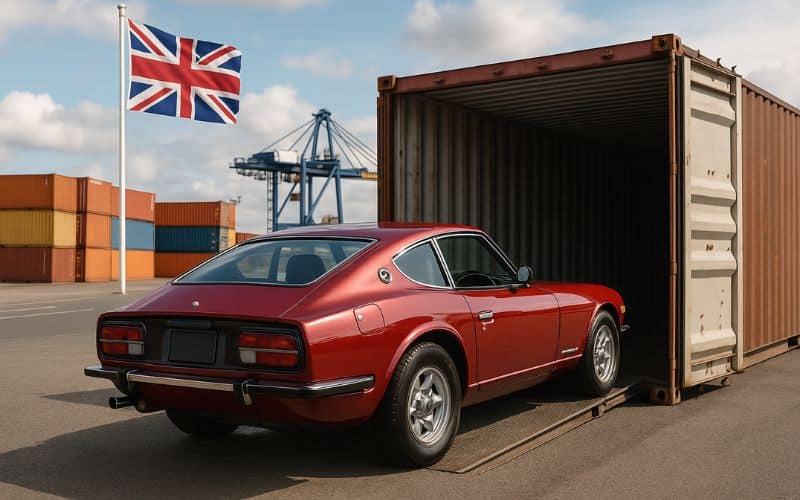
Container shipping means the vehicle is enclosed for the entire journey and handled only twice, once at loading and once at delivery. Household goods are packed around and above it, which uses the container efficiently and cushions the load. The car is secured with soft straps rather than chains to avoid stressing the suspension and undercarriage, wheel blocks and padding prevent movement in transit, and low-clearance vehicles are loaded with additional care. Everything then travels as one shipment under one bill of lading, clears customs as a single entry, and arrives at your UK address together. Our car shipping to the UK page covers how vehicle transport fits into the wider household move.
Preparing a Collector Vehicle for Ocean Transit
Preparation for a collector vehicle goes beyond the standard checklist, because the documentation you create before loading is what protects you if anything is disputed later.
Build a condition record first. Photograph the vehicle comprehensively in good light before it goes anywhere near the container, covering panels, wheels, interior, engine bay, and any existing imperfections. Note anything already present rather than hoping it goes unnoticed, because an honest baseline is what makes a later claim credible. If the vehicle has meaningful value, obtain an independent written valuation as well. Insurers and HMRC both work from documented figures, and a valuation prepared after a problem arises carries far less weight than one prepared before departure.
The mechanical preparation is more familiar. The vehicle should be cleaned inside and out, since UK customs inspects for soil and organic material and a dirty undercarriage can trigger a hold. Fuel should be reduced to a quarter tank or less for safety compliance during ocean transit. Alarms should be disabled so they do not drain the battery over a long crossing, and any loose or removable items should come out of the cabin. Gather your ownership paperwork at the same time, including the title, current registration, and any restoration or provenance records, which matter more for a collector vehicle than for a standard import. Standard marine coverage may not reflect what your vehicle is actually worth, so it is worth reviewing our international moving insurance options and declaring the correct value rather than accepting a default limit.
UK Customs and Transfer of Residence for Collector Cars
Every vehicle entering the UK clears through HMRC, and high-value vehicles reliably attract closer scrutiny than ordinary household imports.
Transfer of Residence relief, applied for on form ToR1, is the mechanism that allows people relocating their primary home to the UK to import household goods and a vehicle without paying VAT or import duty. The core conditions are that you are genuinely moving your main residence, that you have owned and used the vehicle for at least six months before shipping, and that the application is approved before the shipment arrives. Relief also requires that the vehicle is for personal use, and it cannot be sold or transferred within twelve months of arrival. For a collector who may be considering a sale, that restriction deserves attention before rather than after the claim is made.
Valuation is where collector vehicles differ most. HMRC assesses duty and VAT against the vehicle’s value, and an unusual or appreciating car cannot be assessed from a standard price guide. Supporting documentation, including an independent valuation and provenance records, is what keeps the assessment grounded in reality. Shipping the vehicle inside your household container also means the whole shipment clears under a single ToR1 reference and a single entry, which reduces the number of places a discrepancy can appear. Our UK customs forms guide sets out the full documentation requirements, including how ToR1 works alongside the rest of your household paperwork.
Historic Vehicle Status and UK Road Rules
Age works in favor of a classic car once it reaches the UK, and several requirements that apply to modern imports fall away entirely.
Most imported vehicles under ten years old need Individual Vehicle Approval, known as IVA, before the DVLA will register them. That inspection covers lighting, emissions equipment, brakes, tires, and glass markings, and it is the step that catches owners of newer imports off guard. Vehicles older than ten years generally fall outside the IVA requirement and follow a simpler registration route, which means most genuine classics avoid the process that causes the greatest delay for modern cars.
The UK also operates a historic vehicle tax class for cars built more than forty years ago, applied on a rolling basis. Vehicles in that class are generally exempt from vehicle excise duty and from annual MOT testing, though owners remain responsible for keeping the car roadworthy and many choose to have it tested voluntarily. Separately, HMRC may treat a vehicle over thirty years old as a collector’s item for import purposes where it is in original condition, no longer in production, and of genuine historical interest, which can affect how VAT is applied. Both classifications depend on the specific vehicle, and HMRC and the DVLA are the authorities on which applies to yours, so confirm your position before you assume a relief is available. One practical point remains regardless of age: an American classic is left-hand drive, and while that is entirely legal on UK roads, it changes the experience of driving on narrow lanes and overtaking.
Arrival, Delivery, and Storage Options
Once your container clears customs, SDC coordinates delivery to your UK address rather than leaving the vehicle at the port for you to collect.
Delivery is scheduled with you in advance, and access is planned before the vehicle arrives. Narrow streets, permit requirements, and restricted access are ordinary facts of life in older British towns and in central London, and they are much easier to solve a week ahead than on the morning itself. The container is unsealed under supervision, and the vehicle is offloaded first so that it never comes into contact with household items during unloading. Household goods follow, delivered against the inventory prepared at origin.
Timing does not always cooperate. Completion dates slip, tenancies start later than planned, and renovation runs long, which is a particular problem when the shipment contains a vehicle that should not sit outdoors. Secure storage in the UK covers that gap, holding the shipment including the vehicle until your property is ready, and our UK storage services page explains how that works in practice. For a full picture of how the wider relocation fits together, our UK moving services page covers what SDC handles at every stage, and our guide to moving from America to the UK walks through the process from first steps to settling in. To talk through a specific vehicle, call us at (888) 909-3020.
Frequently Asked Questions
Can I ship a classic car from the USA to the UK on its own?
Not through SDC. We ship vehicles inside containers alongside household goods as part of a full relocation, and we do not offer standalone vehicle transport. For a collector car this is generally the better arrangement anyway, because the vehicle stays enclosed for the whole crossing, is handled only at loading and delivery, and clears customs as part of a single shipment rather than as a separate import with its own paperwork.
Does a classic car qualify for ToR1 relief?
It can, provided you are relocating your primary residence to the UK, you have owned and used the vehicle for at least six months before shipping, and your application is approved before the shipment arrives. The vehicle must be for personal use, and you cannot sell or transfer it for twelve months after arrival. That last condition matters if a sale is anything you are contemplating. HMRC decides eligibility case by case, so confirm your position before committing.
Will my classic car need an IVA test or an MOT in the UK?
Most vehicles over ten years old fall outside the Individual Vehicle Approval requirement, so genuine classics usually avoid the inspection that delays newer imports. Cars built more than forty years ago may also qualify for the UK historic tax class, which generally carries exemption from vehicle excise duty and annual MOT testing. You remain responsible for roadworthiness either way, and many owners still have the car tested voluntarily. The DVLA confirms which route applies to a specific vehicle.
How should I insure a high-value vehicle during shipping?
Declare the vehicle’s actual value rather than accepting a standard coverage limit, and support that figure with an independent written valuation obtained before the car is loaded. Take a full photographic record of its condition at the same time. Standard marine cargo coverage is written around ordinary household goods and may not reflect what a collector vehicle is genuinely worth, so review the coverage terms specifically rather than assuming the default is adequate.